Roofing Estimate Generator
A roofing estimate turns a job into a number the homeowner can weigh up — the roof area, the tear-off and materials, and the labor to fit it. List those, and the builder below totals them into an estimated price with a date it holds until. It runs in your browser, exports free as an image, and there is no account to open.
- How do I make a roofing estimate?
- Enter your roofing company and the client, note the roof area, and add lines for materials — shingles, underlayment, flashing — and for labor, including tear-off and installation. The builder totals them into the estimated price, and you add a valid-until date so the figure is not open forever. Export it free as a PNG or a Pro PDF to send for approval. An estimate is an approximate price; once the job is agreed and done, the same lines become the invoice.
Optional extra rows printed under the header — e.g. Store #, Terminal, Order type.
Add your own total lines — a discount (use a negative amount), service charge, deposit or rounding. They fold into the total.
Price a roofing job before you start
A roofing estimate is how a homeowner finds out what a new roof will cost before committing to it. It has to account for the size of the roof, the materials that will cover it, and the labor to strip the old one and fit the new — which is more than a single number can convey on its own. The builder below sets those out as lines, totals them into an estimated price, and lets you add a date the figure holds until, so the customer has something clear to approve.
It runs in your browser, so your pricing and the client's details stay on your device, and a complete estimate exports as a PNG for free. For a roofer quoting jobs week in and week out, the Pro upgrade adds a watermark-free PDF and saves your company details across estimates. The totals are handled for you, so whether a job is a simple re-roof or a larger tear-off, the estimate adds up correctly.
What a roofing estimate includes
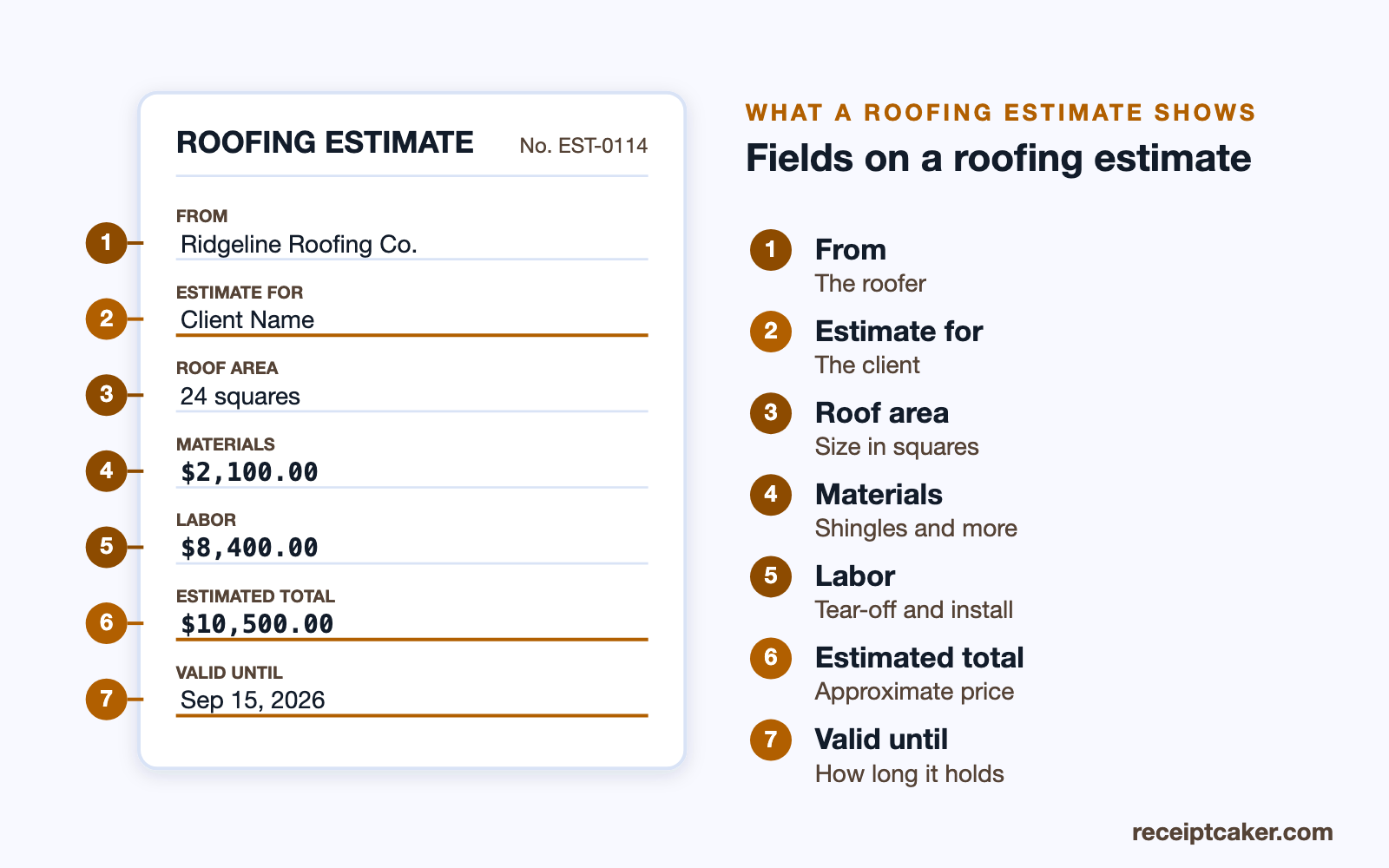
A roofing estimate names your company and the client, identifies the property, and states the roof area — usually in squares, where a square is 100 square feet. It separates materials from labor: shingles, underlayment, and flashing on one side, and the work of tearing off the old roof and installing the new one on the other. Below the lines come the estimated total, a valid-until date, and a note of what the price does and does not cover, such as permits, disposal, or structural repair.
That scope note is not a formality — it is the part that prevents an argument later. When the estimate spells out the area, the materials, and what is excluded, the homeowner knows exactly what they are approving. The diagram below labels the fields a roofing estimate carries.
How roofing work is priced
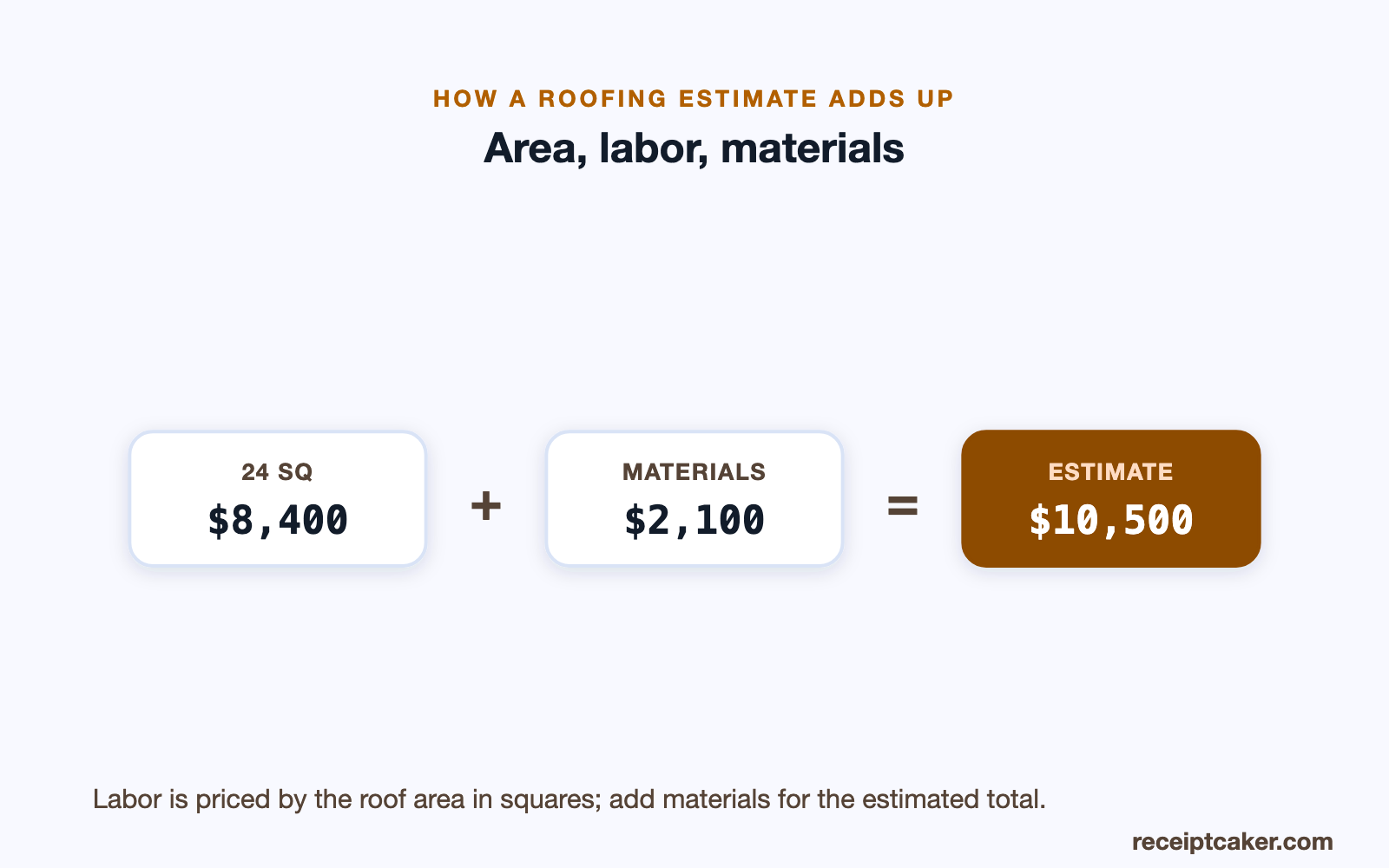
Roofing is usually priced around the roof area, because the area drives both how much material is needed and how long the work takes. You measure the roof in squares, apply your rate for tear-off and installation, and add the materials on top to reach the estimate. The steepness of the roof, the number of old layers to remove, and how easy the roof is to reach all push the labor up or down, so the rate reflects the specific roof rather than a fixed figure.
The builder totals whatever lines you enter, so you price the job from the real roof rather than a rule of thumb. The diagram below shows the shape of the calculation — labor by the area, plus materials, equals the estimate — using round sample figures. Basing the estimate on the actual measurements is what keeps it accurate enough to stand behind.
Estimates, hidden damage, and the final bill
A roofing estimate is an approximate price, and roofing is a trade where that word earns its keep. Until the old covering comes off, no one can see the decking beneath it, and a tear-off can reveal rot or damage that has to be fixed before the new roof goes on. Because of that, a roofing estimate should be given as an estimate, not a fixed quote, with a clear note that hidden repairs would add to the cost.
When the job is done, the final invoice reflects what was actually carried out — the estimated lines, plus any agreed extras for damage found along the way. Telling the homeowner before the cost goes past what they approved is what keeps the relationship intact; springing it on the invoice does not. Build the estimate here, and when the work is complete, the free invoice generator produces the bill from the same details.
Honest estimates for real jobs
A roofing estimate should reflect a job you can genuinely do at the price you are offering. It is the figure a homeowner relies on to make a decision, so quoting a number you do not intend to honour, or describing work you will not do, undermines the trust the estimate exists to build. Every sample in the builder — the roofing company, the client, the line items — is a generic placeholder to replace with the real detail of the job.
Receipt Caker produces the estimate and nothing more. It does not measure the roof, agree the work, or bill anyone; it lays out and totals what you enter, on your own device. Used straight, an estimate is simply how a roofer gives a homeowner a clear, honest price to weigh up — which is the only reason to make one. Keep records of the estimates that become jobs; the IRS advises businesses to retain records generally for about three years.