7 min read
Do I Need a Receipt for a Warranty Claim?
An explanation of when a receipt is required for a warranty claim, what else can serve as proof of purchase, and how to handle a lost receipt for a genuine purchase.
- Do I need a receipt for a warranty claim?
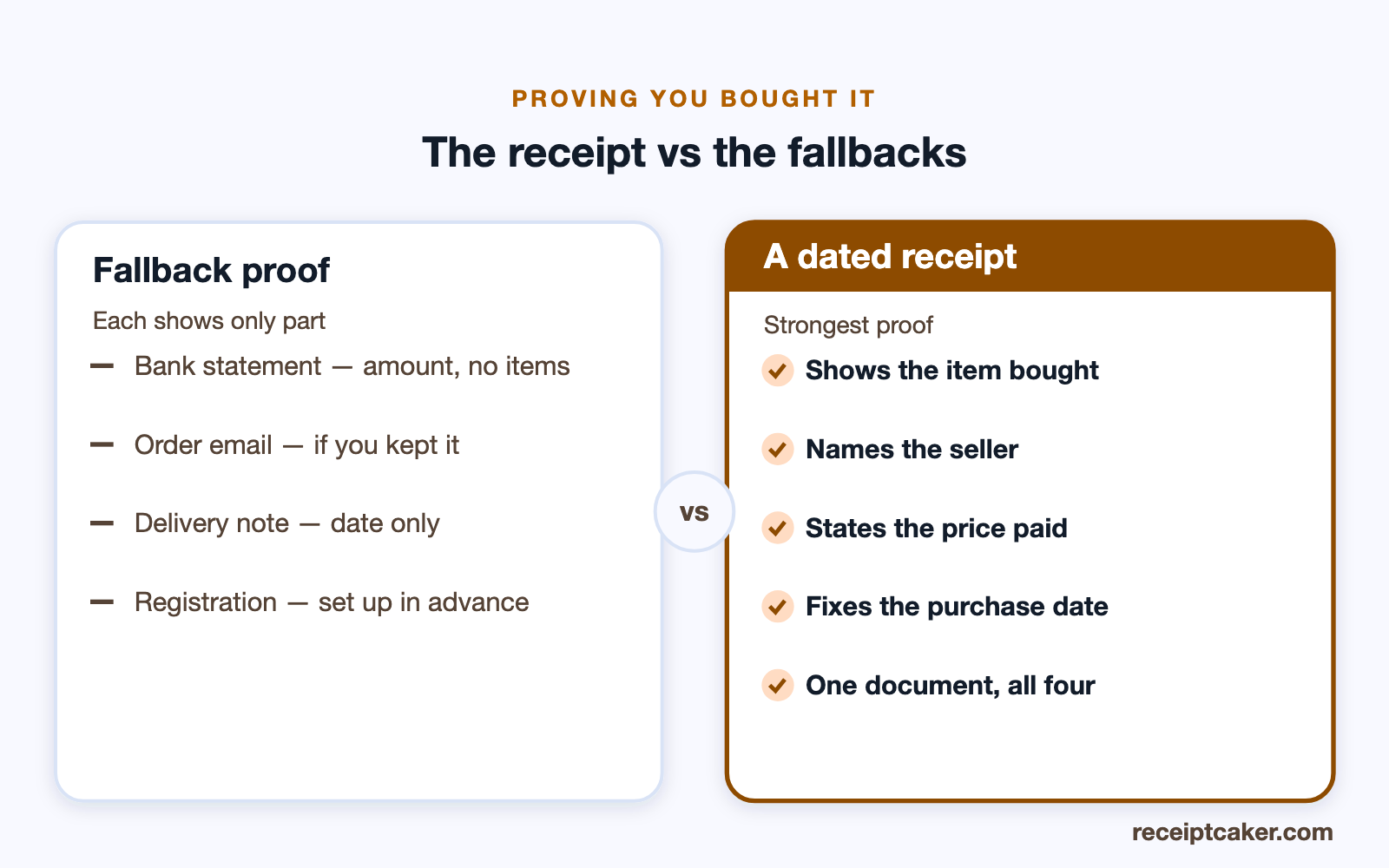
- Receipt Caker can rebuild an accurate PDF of a genuine receipt whose paper has faded, which matters because most warranties require proof of purchase. A dated receipt is the clearest proof, since it shows the item, the seller, the price, and the date the warranty period starts from, so you can document a real purchase you already made and still support a legitimate claim.
Why warranties ask for a receipt
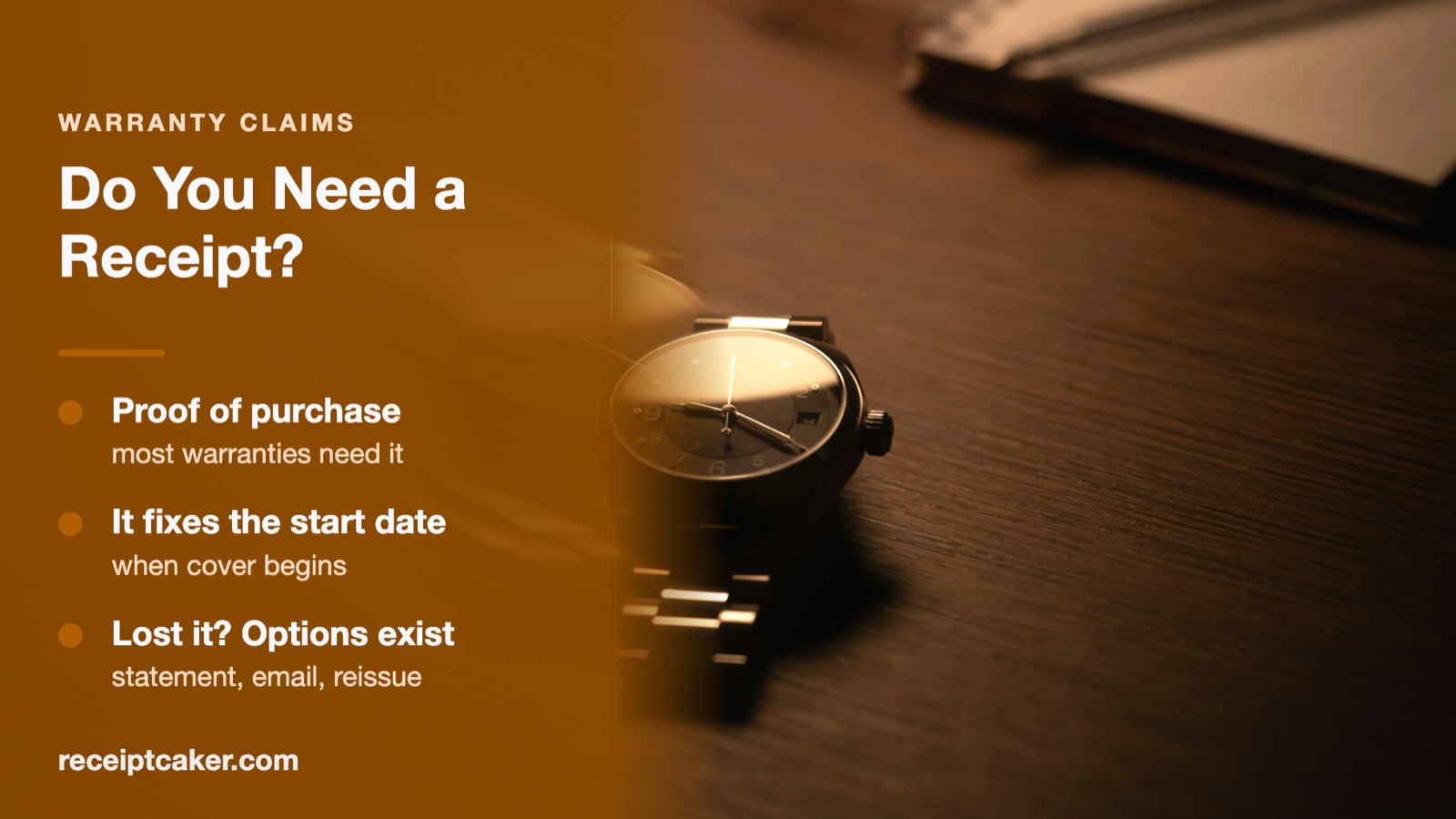
A warranty is a promise to repair or replace a product within a set time from the date of purchase. To honour it, the manufacturer or seller needs to confirm two things: that you bought the item from an authorized source, and when you bought it, since the clock starts from that date. A receipt answers both at once, which is why it is the standard proof of purchase.
Without a purchase date, a warranty provider cannot tell whether your claim falls inside the covered period. Without a seller, they cannot confirm the item was genuine and not a grey-market or counterfeit unit. The receipt closes both questions, which is why most warranty terms name it explicitly as the required document.
Manufacturer warranty versus your other rights
It helps to know which promise you are relying on, because each treats proof differently. A manufacturer's warranty is the voluntary guarantee that comes with the product, and it almost always asks for proof of purchase to establish the start date and the authorized seller. An extended warranty or protection plan you paid for separately works the same way, with its own paperwork you should keep alongside the receipt.
Separate from either, many places give buyers statutory rights against the seller if goods are faulty, and those can apply even when a manufacturer's warranty has lapsed. They too are far easier to exercise with a receipt, since you still have to show what you bought, from whom, and when. Whichever route a claim takes, the dated receipt is the document that underpins it — which is why it is worth keeping for the full length of the cover.
What counts as proof of purchase
A receipt is the strongest proof, but it is not always the only one. Depending on the provider, a bank or card statement showing the transaction, an order confirmation email, a delivery note, or a warranty registration completed at the time of purchase may be accepted, sometimes in combination. The more of these that agree on the item, seller, and date, the stronger your case.
Some manufacturers let you register a product after purchase, which stores the proof on their side and can smooth a later claim. Where a product has a serial number, the provider can sometimes trace the manufacture date, though that only sets an outer bound and rarely substitutes fully for a dated receipt.
When the warranty clock starts
Because a warranty runs for a set time, the date it starts from decides whether your claim is inside the covered period — and that is the single thing a receipt pins down. For most consumer products the clock starts on the date of purchase, which is why the purchase date on the receipt matters so much. Some manufacturers instead start it at the date of delivery, and a few at the date of manufacture or only once you register the product.
Read the specific warranty terms to confirm which start date applies, then keep the document that proves it. In the common case that is your receipt, and its value is precisely that it fixes the start date beyond argument. Without it, a provider is left guessing whether a fault appeared in month eleven or month thirteen of a one-year cover, and the benefit of the doubt rarely falls your way.
Registering the product, and gifts
Registering a product with the manufacturer when you buy it is worth the two minutes it takes. Registration stores the proof of purchase on their side, links it to the serial number, and can make a later claim a matter of quoting your details rather than digging out paperwork. It does not replace the receipt, but it is a useful backup that lives somewhere you cannot misplace.
Gifts need a little thought, because warranty cover usually attaches to the product rather than the person who paid. A recipient can often claim as long as they can show valid proof of purchase, which is exactly why a gift giver should pass along a receipt or a gift receipt with the item. Some warranties are non-transferable or require the original purchaser, so it is worth checking the terms — but in most cases keeping the receipt with the gift is what keeps a future claim simple for whoever ends up owning it.
If you have lost the receipt
Losing the slip does not always end a claim. Start by checking your email for an order confirmation, your card statement for the transaction, and any account with the seller that stores purchase history. Many retailers can reissue a copy of an original receipt if you can tell them roughly when and where you bought the item.
If the purchase was genuine and the paper receipt has simply faded or gone missing, you can reconstruct an accurate record of that real transaction. Receipt Caker recreates the receipt as a clean PDF with the correct seller, date, item, and amount, so you have documentation for a purchase you actually made. This is only appropriate for legitimate purchases — never to fabricate a transaction that did not happen.
Keeping receipts warranty-ready
The best fix for a lost-receipt problem is to never lose the receipt. When you buy something with a meaningful warranty, scan or photograph the receipt the same day and save it as a PDF named with the date and item. Keep these in a dedicated warranties folder alongside the product manual so a future claim is a two-minute retrieval.
Because thermal-paper receipts fade, a digital copy is often more reliable than the original by the time a multi-year warranty matures. Storing the copy at the moment of purchase, backed up to the cloud, means a fridge or laptop bought today still has provable proof of purchase years from now when you actually need it. The habit costs a few seconds at the till and turns a future claim from a frustrating hunt into a quick retrieval.