7 min read
What Is a Receipt?
A clear explanation of what a receipt is, the parts it contains, how it differs from an invoice, and why keeping receipts matters for taxes and returns.
- What is a receipt?
- A receipt is a written record that proves a payment was made and a transaction is complete. Receipt Caker receipts show the seller, the items or services bought, the amounts, any tax, and the total paid — the same details a store or restaurant prints at checkout.
The definition of a receipt
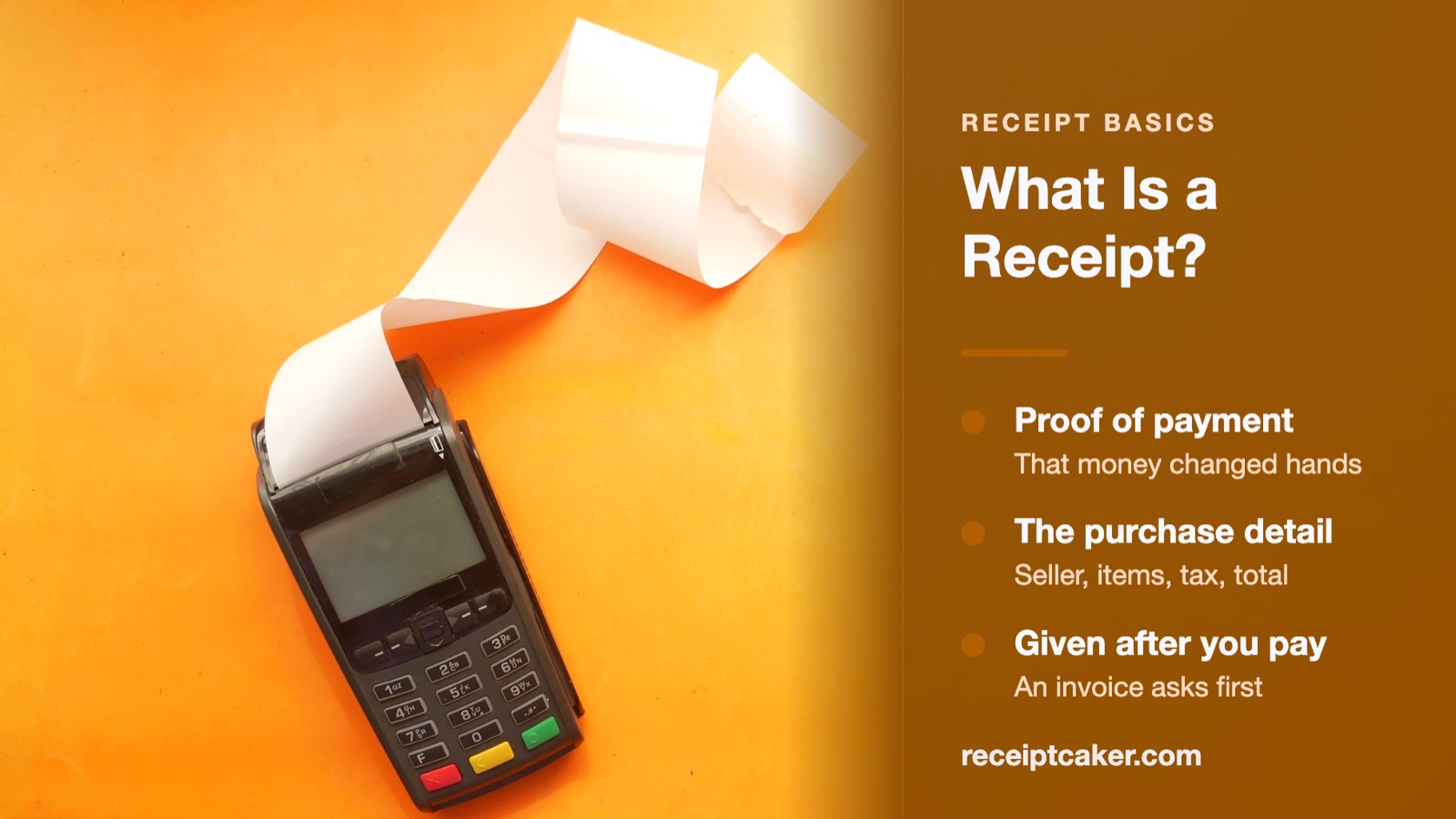
A receipt is a document that acknowledges a payment has been received. It is issued by the seller to the buyer after money changes hands, and it serves as proof that the transaction is complete. Unlike a bill or an invoice, which requests payment, a receipt confirms payment has already happened.
A receipt comes into existence at a specific moment: the point of sale, when the buyer hands over payment and the seller accepts it. That timing is what separates it from every other business document — it looks back at a completed exchange rather than forward at one still owed. For that reason a receipt is usually short and factual; its job is to record what happened, not to negotiate what should.
Receipts can be printed on paper, emailed as a PDF, or shown on a screen. What matters legally is not the format but the information: who sold what, to whom, for how much, and when. Get those four facts right and you have a valid receipt, whether it came off a till roll or out of a generator.
What a receipt contains
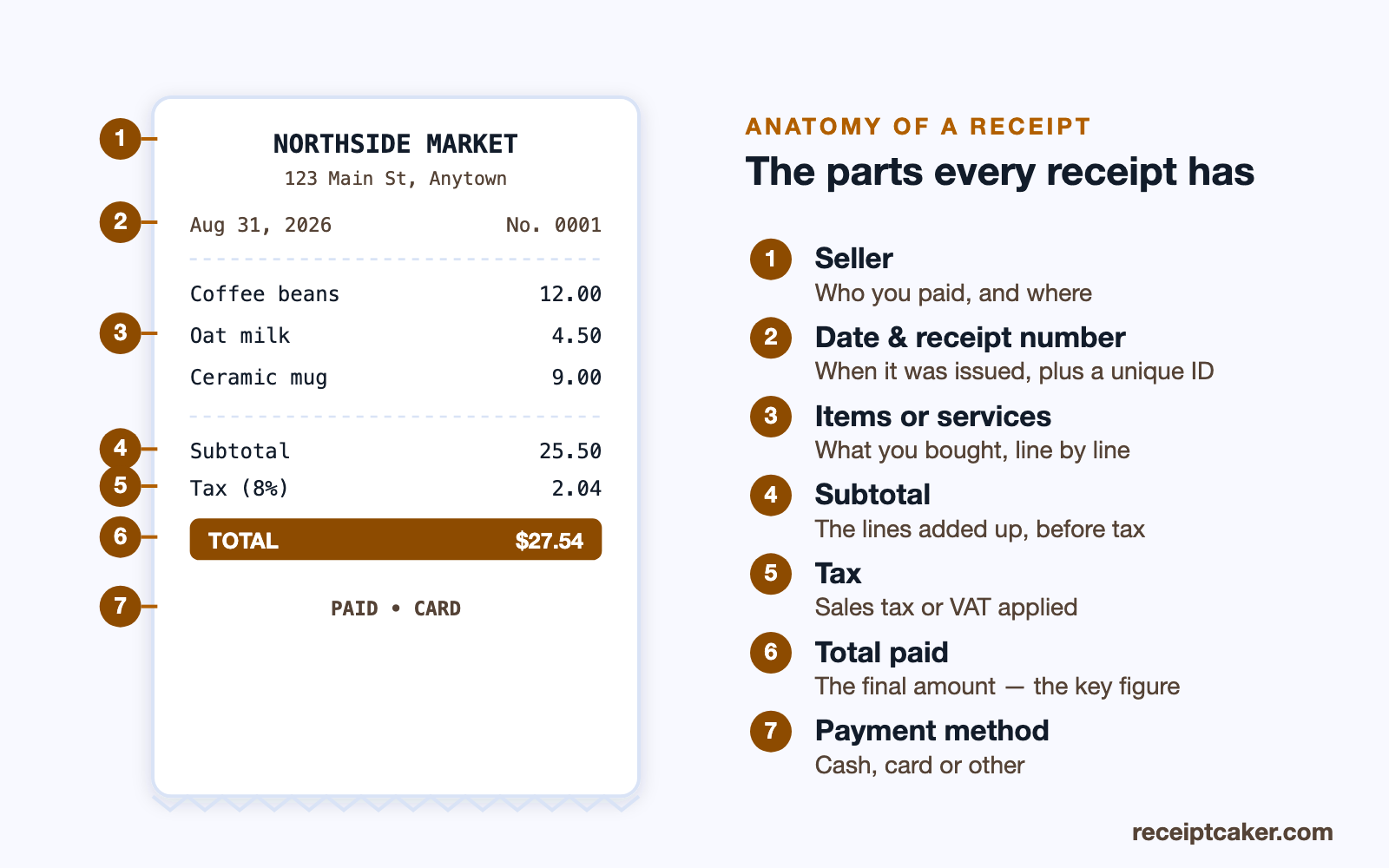
A standard receipt identifies the seller by name and usually address, lists each item or service with its price, and shows the subtotal, any tax as a separate line, and the final total paid. It also records the date and a receipt number — a unique reference for that sale, so it can be looked up, matched to a card statement, or quoted on a return.
Retail and restaurant receipts add details like the payment method, the cashier or server, and sometimes a barcode for returns. Receipt Caker's generator includes all of these fields and calculates the tax and totals automatically, so the subtotal, tax and total always reconcile.
Types of receipts you'll come across
Most receipts do the same job — prove a payment — but they go by different names depending on the setting. A cash receipt records a sale settled in cash; a sales or tax receipt is the everyday checkout receipt that itemises what was bought and the tax charged; and a gift receipt shows proof of purchase without revealing the price, so the recipient can return or exchange an item.
You'll also meet deposit receipts (acknowledging money paid up front, such as a rental deposit) and digital or e-receipts emailed or texted instead of printed. Whatever the label, the essentials are the same: the seller, the amount, the date, and confirmation that payment was made. Receipt Caker can produce any of these from one generator by changing the fields, not the format.
Paper, PDF, or digital?
The format of a receipt has changed far more than its purpose. For decades the default was a thermal-paper slip printed at the register — cheap and instant, but prone to fading within months as the heat-sensitive coating breaks down. That is why a shoebox of old receipts so often turns into a stack of near-blank paper right when you need to read one. Email and text receipts, or e-receipts, solved that by storing the record digitally, where it cannot smudge, fade, or get lost in a coat pocket.
Most businesses now offer a choice, and for anything you might need later — a warranty claim, a tax deduction, an expense report — a digital copy is the safer bet. A PDF is the most portable form: it looks identical on any device, prints cleanly, and files neatly alongside your other records. If all you have is a paper receipt, photographing or scanning it to a PDF captures the details before the ink disappears, which is exactly the kind of durable copy a generator produces from the start.
Receipt vs invoice
The key difference is timing and purpose. An invoice is sent before payment to request money and states what is owed and by when. A receipt is issued after payment to confirm the money was received. A single transaction can involve both: an invoice up front, then a receipt once it is paid.
A worked example makes the split clear. A plumber who fixes a leak might email an invoice for the agreed fee, due in fourteen days. When the customer pays, the plumber sends back a receipt for the same amount, marked paid. Same job, same figure, two documents doing opposite jobs — one asking for the money, the other confirming it arrived.
For cash-and-carry sales like a shop or cafe, there is usually no invoice — the receipt at checkout is the only document, because payment and delivery happen at the same moment. If you raise invoices as well, Receipt Caker's invoice tools handle that side, and the receipt maker covers the proof that follows.
Do you legally have to give a receipt?
Whether a receipt is mandatory depends on where you are and what you are selling, and there is no single global rule. But a common thread runs through most systems: a customer is generally entitled to proof of purchase, and many places require a seller to provide a receipt on request. Tax-registered businesses usually face stricter rules — where a sales tax or VAT applies, the receipt or invoice often has to show the tax charged and the seller's tax number so the buyer can account for or reclaim it.
Even where the law is silent, issuing a receipt is simply good practice, and it protects the seller as much as the buyer. It documents what was agreed, heads off later disputes about what was actually paid, and forms part of the records a tax authority expects a business to keep. If you are unsure of the exact requirement for your trade or location, your local tax or consumer-protection authority is the place to confirm it — the rules genuinely vary from one place to the next.
Why receipts matter — and how long to keep them
Receipts are the backbone of bookkeeping. They substantiate business expenses for tax deductions, support warranty and return claims, and provide the paper trail auditors and accountants rely on. For individuals, keeping receipts makes it far easier to track spending, split shared costs, and get reimbursed.
How long to hold onto them comes down to tax. In the US, the IRS can generally go back three years to examine a return, so keeping receipts for at least that long is the safe baseline; some situations stretch it further. Businesses don't need a paper receipt for every small expense — the IRS doesn't require documentary proof for most costs under $75 — but should keep one for anything above that. Storing receipts as PDFs makes long retention easy and avoids the fading that ruins thermal-paper printouts.
If you've lost a receipt for a genuine purchase, you can reconstruct an accurate record with a generator — provided you only recreate a legitimate transaction and never use it to misrepresent a sale or deceive anyone. That line matters: a receipt is proof of something that actually happened.