
7 min read
How to Make a Receipt for a Cash Payment
A step-by-step guide to making a cash payment receipt — the fields it needs, why the receiver should sign it, and how both sides keep a copy.
- How do I make a receipt for a cash payment?
- Write who paid, who received the money, the amount in figures, the date, and what the payment was for, mark it as cash, and have the receiver sign it. Receipt Caker lays out these fields with a space to sign, so you can make a cash receipt in under a minute and give the payer and the receiver each a copy.
Why cash payments need a receipt
A card or bank transfer leaves an automatic record; cash does not. Once the notes change hands there is nothing to show the payment happened unless someone writes it down. That is why the receipt matters more for cash than for any other method — it is the only proof either side has that the money was paid and accepted. In effect, the receipt is doing by hand the job a bank statement does automatically for every card payment: creating a dated, independent record that the money moved.
Without one, a disagreement over rent, a deposit, or a private sale becomes one person's word against another's. A dated receipt, signed by the person who took the money, settles the question before it starts. Many places specifically require a written receipt whenever rent or a bill is paid in cash for exactly this reason.
What a cash receipt should show
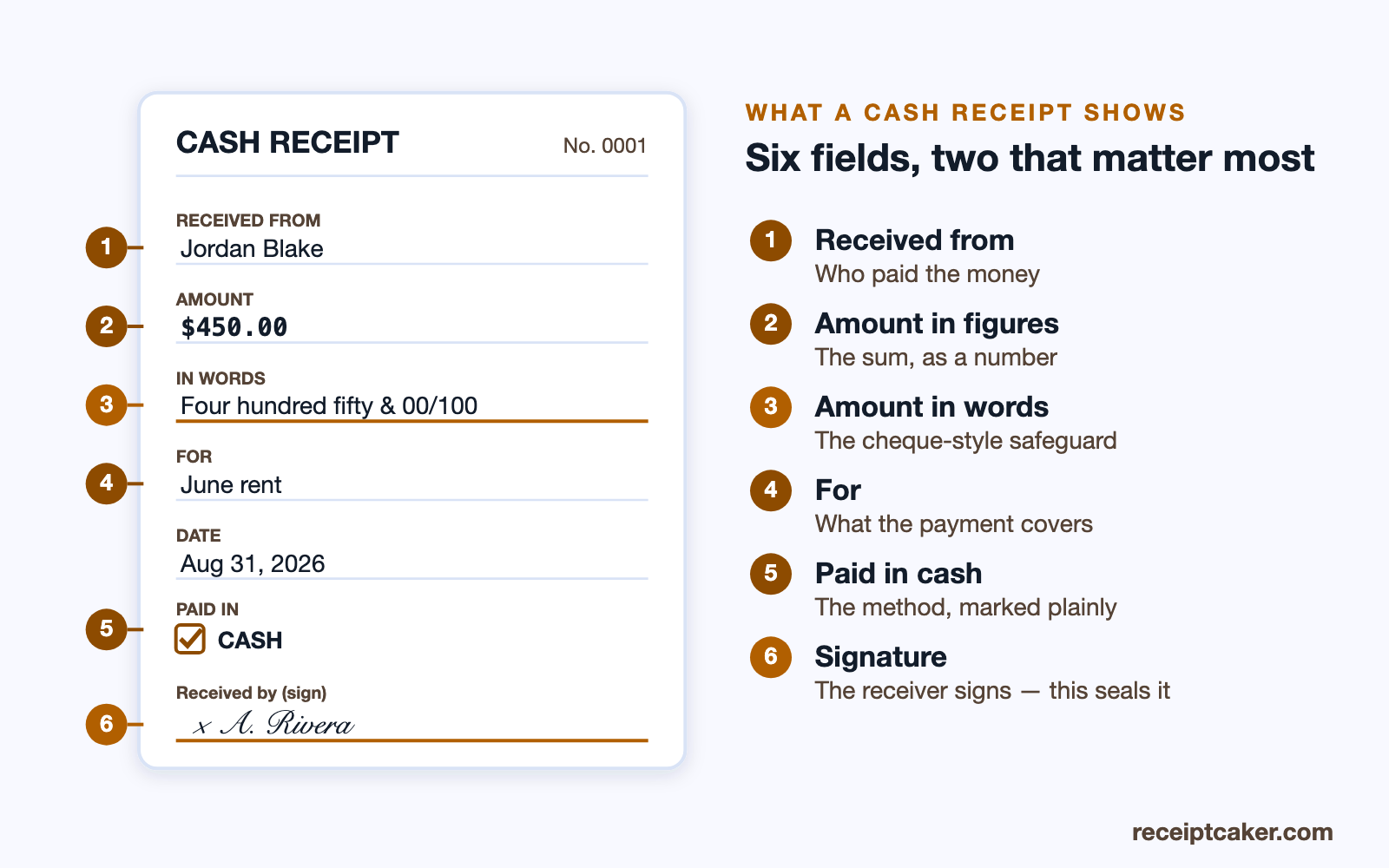
A cash receipt names the person who paid and the person or business who received the money, states the amount, gives the date it was paid, and says what the payment was for — rent for a named month, a described item, a service rendered. Marking it clearly as a cash payment removes any ambiguity about the method.
Write the amount both in figures and in words — "$450.00" and "four hundred and fifty dollars" — the same safeguard a cheque uses. Two records of the number make it far harder for anyone to alter a digit later, and they catch honest slips too. The description line then does more work than it looks: tying the money to a specific purpose is what lets the receipt answer a later question — that this was June's rent, not a loan or a deposit — so be specific rather than vague.
When a cash receipt matters most
Some cash payments are worth documenting more than others. Rent paid in cash is the classic case — it recurs, the amounts are large, and a deposit or an eviction dispute can turn on whether a month was paid. Private sales of valuable items (a used car, furniture, electronics) are another: the receipt is the buyer's proof of ownership and the seller's proof the deal closed. Security deposits, cash paid to a contractor or handyman, tips and wages, and loan repayments between individuals all belong on paper for the same reason.
The common thread is that the payment could be questioned later and there is no bank record to settle it. If a cash transaction is small and instantly forgotten — a coffee, a market stall — a receipt is optional. The moment the amount is significant or the relationship is ongoing, write one.
Why the signature matters
A cash receipt is strongest when the person receiving the money signs it. The signature is what confirms the cash was actually handed over and accepted, turning the document from a note into acknowledged proof. For a later dispute — an unreturned deposit, a payment the other side denies — a signed receipt carries far more weight than an unsigned one.
Leave a clear space for the receiver to sign before the payer takes their copy. Both sides should walk away with the same document, so the payer can prove they paid and the receiver has a record of the income. If the receiver is a business rather than an individual, adding a printed name and role beside the signature makes it clearer still who accepted the money on the company's behalf.
Numbering and keeping a running record
For anything recurring, give each receipt a number and keep them in sequence. A landlord taking cash rent from several tenants, or a trader with regular cash customers, needs to tell one payment from another and prove none is missing — sequential numbering does that, and a gap in the run is an immediate flag. Many people keep a simple cash receipt book or a running log alongside the receipts themselves, noting date, payer, amount and purpose so the month can be totalled at a glance.
Whatever the format, both sides keep a copy. If one is lost the other survives, and because two identical records exist, neither party can quietly alter their version without the discrepancy showing. That shared-record habit is most of what makes a cash receipt trustworthy.
Cash receipts, income and tax
Cash income is still income. Because there is no automatic bank trail, the receipt often becomes the primary record for your books — the thing that lets you report earnings correctly and back up a figure if you are ever asked to. Keeping the receiver's copy is what turns a pile of banknotes into an accountable transaction.
Retention follows the same rules as any receipt. In the US the IRS can generally look back three years, so keeping cash receipts at least that long is the safe baseline, and businesses should hold a documentary receipt for expenses above $75. A cash receipt template that captures the parties, amount, date and purpose gives you exactly the record a bookkeeper or tax authority expects.
Making one quickly — and keeping it honest
You can write a cash receipt by hand, but a generator or a ready-made template keeps the fields consistent and legible, which matters if the receipt is ever produced as evidence. Enter the two parties, the amount in figures and words, the date and the purpose, and the layout — including the cash marker and the signature line — is done for you. It is the fastest way to produce something that looks and functions like a proper receipt rather than a scribbled note.
Export the finished receipt as a PDF or image and give each party a copy. Everything is composed in your browser, so the details of a private cash payment are not uploaded anywhere. For a genuine payment this is the record both sides should keep — but it must only ever document money that actually changed hands. A receipt for a payment that never happened is worthless and, if used to deceive, illegal.
Steps at a glance
- 1Name both parties. Write who paid and who received the money.
- 2State the amount and date. Show the amount in figures and the date the cash was paid.
- 3Say what it was for. Describe the payment — a month's rent, an item, a service.
- 4Mark it as cash. Note that payment was made in cash so the method is unambiguous.
- 5Sign and share a copy. The receiver signs, and each side keeps an identical copy.