
7 min read
How to Make Rent Receipts
A guide to making rent receipts — the fields they need, why cash rent especially needs one, and how to issue a signed receipt for each period.
- How do I make a rent receipt?
- Write the tenant and landlord names, the rental property address, the period the payment covers, the amount paid, the date received, and the payment method, then sign it. Receipt Caker's rent receipt layout includes all of these with a signature space, so you can issue a signed receipt for each period in under a minute and give the tenant a copy.
What a rent receipt records
A rent receipt is the landlord's confirmation that a tenant has paid rent for a given period. It names the tenant and the landlord, gives the property address, states the period the payment covers and the date it was received, and shows the amount paid and how. Tenants keep them to prove payment, to settle a deposit dispute, to support a housing-benefit or immigration application, or simply to keep their records straight.
Issuing one receipt per period builds a clean, matching record for both sides. The tenant can show they paid on time, and the landlord has an ordered log of rental income. Keeping them in sequence means a missing payment stands out immediately, which is why a numbered rent receipt beats a scribbled note every time.
What to put on a rent receipt
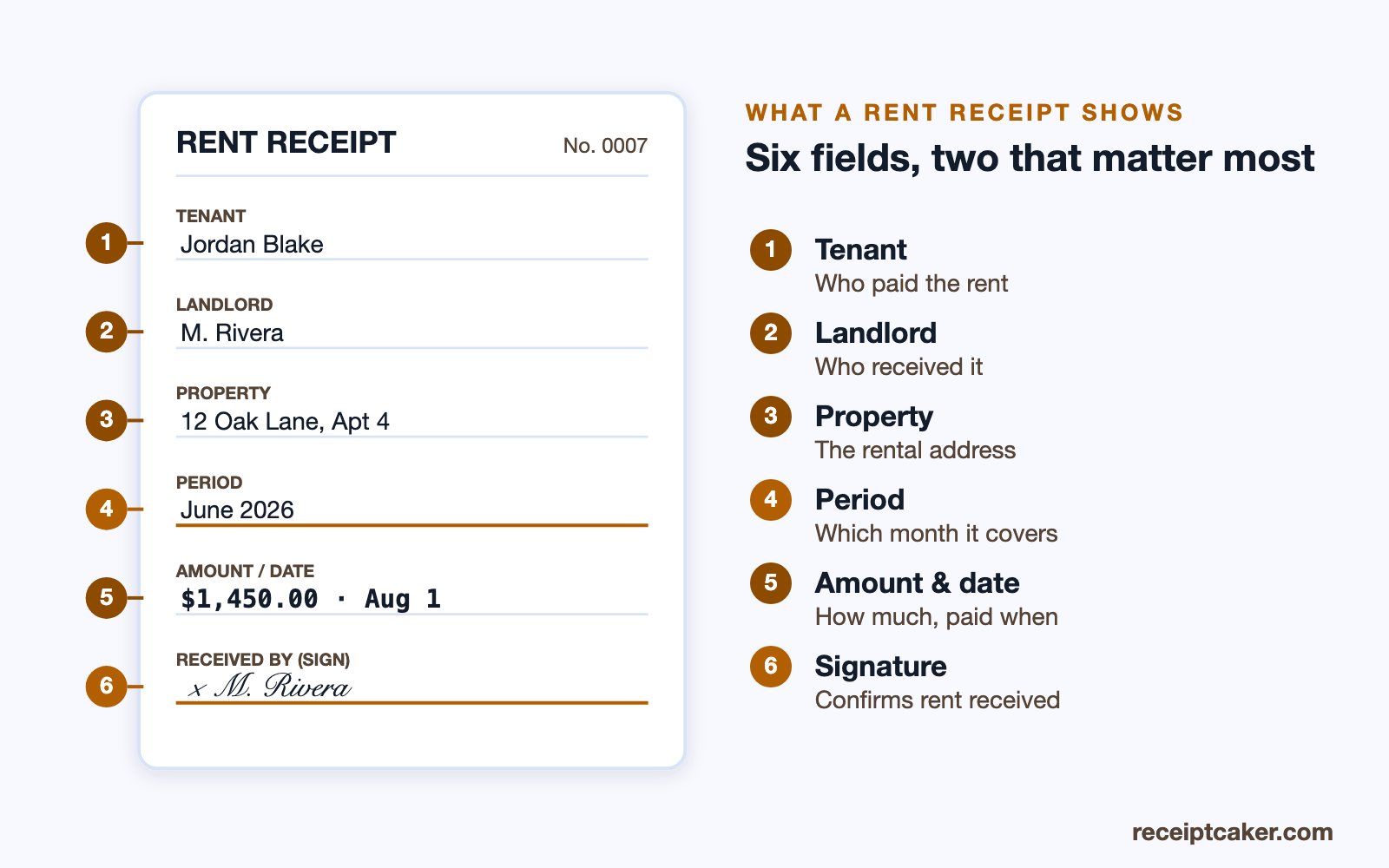
A complete rent receipt carries a specific set of fields, and a good rent receipt template simply lays them out for you: the tenant's name, the landlord or agent's name, the rental property address, the period the rent covers (a named month or a date range), the amount paid, the date it was received, and the payment method — cash, cheque, card or transfer. A receipt number keeps a run of them in order.
Two fields carry extra weight. The period is what ties the money to a particular month, so a deposit dispute cannot later argue about which rent was paid; and a space for the landlord's signature is what turns the document from a claim into acknowledged proof. Fill every field in the same way each month and the receipts form a consistent, trustworthy record.
Cash rent especially needs a receipt
When rent is paid in cash there is no bank statement to fall back on, so the receipt is often the only proof the payment ever happened. That is why many states and cities specifically require a landlord to provide a written receipt whenever rent is paid in cash, and why a tenant paying cash should insist on one.
Even where rent is paid by transfer, a receipt adds a clear record that ties the payment to a specific period and confirms it was accepted as rent rather than something else. For cash, though, it is not optional in practice — without it, a later disagreement comes down to one person's word against another's.
Partial payments, late rent and extras
Not every payment is a clean month's rent, and the receipt should say so plainly. If a tenant pays only part of the rent, record the amount actually paid and note the balance still owed for the period, rather than writing a receipt that implies the month was settled in full. The receipt is evidence, and it should match what really changed hands.
Keep other charges on their own lines too. A late fee, a pet fee, or a utility contribution is not rent, so labelling each separately stops the receipt being misread and keeps the rental income figure clean for the landlord's books. Clear, honest lines now save an argument later.
Signing and issuing one per period
A rent receipt is strongest when the landlord or their agent signs it. The signature confirms the money was received and turns the document into acknowledged proof, which carries far more weight in a later deposit dispute or payment question than an unsigned note. Leave a clear space for it and sign before handing the receipt over.
Issue a receipt for each rent payment as it is made, rather than reconstructing them at the end of a tenancy. A receipt created at the time, signed, and given to the tenant is trustworthy in a way that a batch produced months later is not. Both sides should keep a copy of each one, so if a tenant's copy is lost the landlord's still exists.
Rent receipts, income and records
For a landlord, rent receipts are more than a courtesy to the tenant — they are the running log of rental income that underpins the year's bookkeeping and tax return. Because each receipt ties an amount to a date and a property, a full set adds up to the income figure with none of the guesswork that comes from reconstructing payments after the fact.
Retention follows the usual rule: in the US the IRS can generally look back three years, so keeping rent receipts at least that long is the safe baseline, and many landlords keep them for the life of the tenancy plus several years beyond. Tenants have their own reasons to hold onto them — proof of residence, a reference for the next landlord, or evidence in a deposit claim — so both sides benefit from a durable copy.
A landlord managing several units gains the most from keeping them tidy. At tax time, a labelled folder of monthly receipts per property turns what could be a scramble into a simple total, and it is exactly the documentation an accountant or a tax authority expects to see. Numbering the receipts and filing them by property and month means any gap is obvious at a glance, long before it becomes a problem.
Issuing them every month without the hassle
Because rent recurs, you will issue many near-identical receipts, so a tool that holds the standing details — the tenant, the landlord, the property — and just needs the period and amount each time saves real effort. A generator or a saved rent receipt template arranges the fields, including the signature line, and produces a consistent receipt every month, numbered in sequence.
Fill in the period and amount, export a PDF or image, sign it, and give the tenant their copy while keeping yours. Everything is composed in your browser, so the tenancy details are not uploaded anywhere. Local rules on when a rent receipt is required vary, so check what your state or city asks for — the tool produces the receipt but does not give legal advice, and it should only ever record rent that was genuinely paid.
Steps at a glance
- 1Name the tenant and landlord. Write both names so it is clear who paid and who received the rent.
- 2Add the property and period. Give the rental address and the period the payment covers.
- 3State the amount and date. Show the amount paid, the date received, and the payment method.
- 4Sign the receipt. The landlord or agent signs to confirm the rent was received.
- 5Export and keep copies. Give the tenant a copy and keep one for your records, one per period.