7 min read
Receipt vs Bill of Sale
An explanation of how a receipt differs from a bill of sale, what each document proves, and which one you need for private sales of cars, equipment, and other property.
- What is the difference between a receipt and a bill of sale?
- Receipt Caker generates the receipt side — proof that a payment was made for a completed sale. A bill of sale is different: it documents the transfer of ownership of a specific item from a seller to a buyer, and is often used for cars, boats, and equipment. The two are sometimes used together, the receipt proving payment and the bill of sale proving ownership changed hands.
What each document does
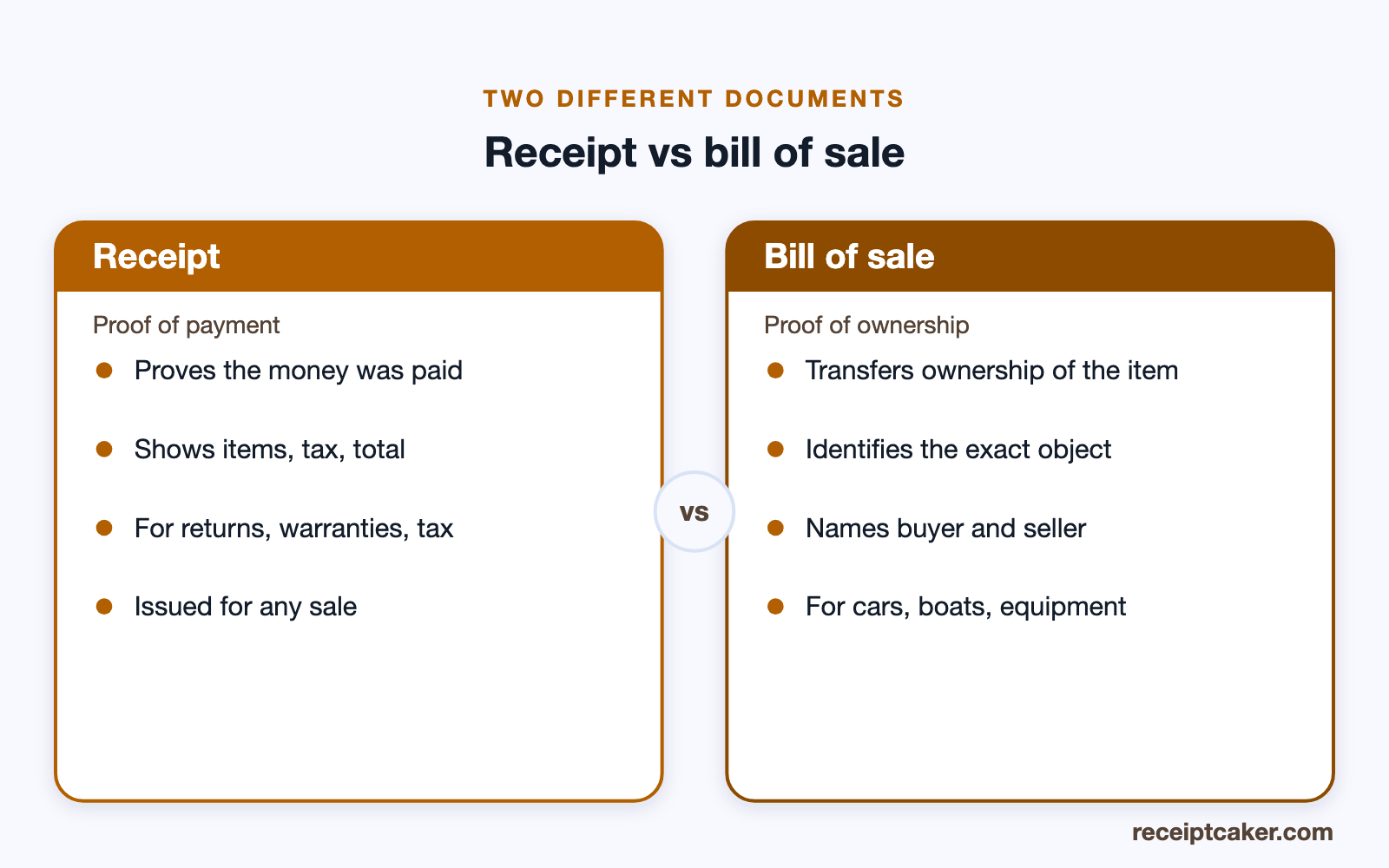
A receipt is proof of payment. It confirms that money changed hands for goods or services and records the seller, the items, the amounts, the tax, and the total paid. Its job is to show that a transaction is settled, which is why it matters for returns, warranties, expenses, and bookkeeping.
A bill of sale is proof of ownership transfer. It states that a named seller has sold a specific, identified item to a named buyer, usually with a description detailed enough to pin down that exact object — a vehicle by its identification number, for example. Its job is to establish who now owns the thing, not merely that a payment occurred.
Titled property and notarization
The reason a bill of sale matters most for cars, boats, and trailers is that these are titled — ownership is recorded by an agency, and transferring the title is a formal step. A bill of sale is the document that supports that transfer, telling the motor-vehicle office who sold the item to whom, for how much, and when, so the new owner can register and insure it in their name.
Because it feeds an official process, a bill of sale sometimes carries extra requirements a plain receipt never does. Some jurisdictions provide a specific form that must be used, require the seller's signature to be notarized, or ask that a copy be filed with the agency within a set number of days. These rules vary widely by place and by the type of item, so check what applies where the sale happens rather than assuming a generic document will be accepted.
Which to keep, and for how long
When both documents exist, keep both, because each proves something different. The receipt substantiates the amount paid, which is what matters for an expense deduction or for reconciling your books. The bill of sale documents that you acquired or disposed of a specific asset, which can matter for capital gains, depreciation, or simply proving you owned an item before you sold it on.
For significant purchases like a vehicle or a piece of equipment, file the receipt and the bill of sale together so the record is complete. Keep them at least as long as the tax authority can question the related return — in the US the IRS can generally look back three years — and often longer for an asset you still own, since you may need the paperwork when you eventually sell it.
When you need a bill of sale
Bills of sale come into play for higher-value or titled property, especially in private sales between individuals. Selling a used car, a boat, a trailer, a piece of machinery, or livestock typically calls for one, because the buyer needs documented proof of ownership to register the item, insure it, or resell it later.
The document identifies both parties by name and often address, describes the item precisely, states the price and date, and is frequently signed by the seller and sometimes the buyer. In some places a bill of sale for a vehicle must be notarized or filed with an agency as part of transferring the title, so local requirements matter.
When a receipt is enough
For everyday goods and services — a repair, a batch of supplies from a vendor like Northgate Supplies, a meal, a consulting session — a receipt is all that is needed. Ownership of a coffee or a box of parts is not something anyone needs to formally trace, so proof of payment fully covers the transaction.
A receipt is also the right document when payment happens at the same moment as delivery and there is no title to transfer. The buyer walks away with both the goods and proof they paid, and no separate ownership record is required. This is why shops and restaurants issue receipts and never bills of sale.
Can one document be both?
People sometimes try to make a single document do both jobs, and it can — but only if it actually contains the elements of each. That means the proof-of-payment details of a receipt plus a precise description of the item and a clear statement that ownership has transferred. Miss either half and the document is only doing one job while looking like it does both.
For titled property such as a vehicle, this is where a plain receipt falls short: many jurisdictions require a specific bill-of-sale format to transfer the title, so a receipt alone will not satisfy the motor-vehicle office no matter how detailed it is. When the stakes are high, two clear documents beat one ambiguous one — a receipt that proves payment and a proper bill of sale that meets the local rules for the item.
For the private seller
If you are selling something valuable to another individual, a little documentation protects you as much as the buyer. Describe the item precisely — make, model, serial or identification number, condition — so there can be no argument later about what changed hands. State the price and the date, note that the sale is as-is if that is the agreement, and have both parties sign. For a vehicle or boat, add the details the title transfer will need.
Then hand over both documents: a bill of sale that records the transfer and a receipt that confirms the money was received. The buyer walks away able to register and insure the item and to prove they paid for it; you keep signed copies that show you sold it, for what, and when. Receipt Caker produces the receipt half cleanly; pair it with a bill of sale that meets your local requirements.
Using both together
The two documents are not mutually exclusive. In a private car sale, the seller might give the buyer a bill of sale to transfer ownership and a receipt to confirm the payment was received — the bill of sale proves the deal, the receipt proves it was paid. Together they give the buyer a complete paper trail.
If you are the seller in such a transaction, Receipt Caker handles the receipt half cleanly, producing an itemized proof of payment with the price, any tax, and the date. Pair it with a properly drafted bill of sale that meets your local rules for the item being sold, and both sides have exactly the documentation they need.