7 min read
How to Make a Deposit Receipt
A step-by-step guide to creating a deposit receipt that records an upfront partial payment, the balance owed, and the terms, protecting both buyer and seller.
- How do I make a deposit receipt?
- Receipt Caker lets you itemize the order, enter the deposit as a payment, and show the outstanding balance, then export a clean PDF both sides can keep. Label the document clearly as a deposit receipt, record both parties and the date, and show three figures: the full price, the deposit paid, and the balance still owed, along with the terms and payment method.
What a deposit receipt is for
A deposit receipt confirms that a customer has paid part of a price upfront and that a balance remains. It is common for custom orders, bookings, repairs, and services where the seller needs a commitment before starting work and the buyer wants proof they have secured the goods or the slot. The defining feature is that it records a partial payment against a larger total.
Because money changes hands but the transaction is not yet complete, the receipt has to make the incomplete state obvious. A deposit receipt that reads like a full-payment receipt invites disputes about how much is still owed, so clarity about the balance is its most important job.
The three numbers it must show
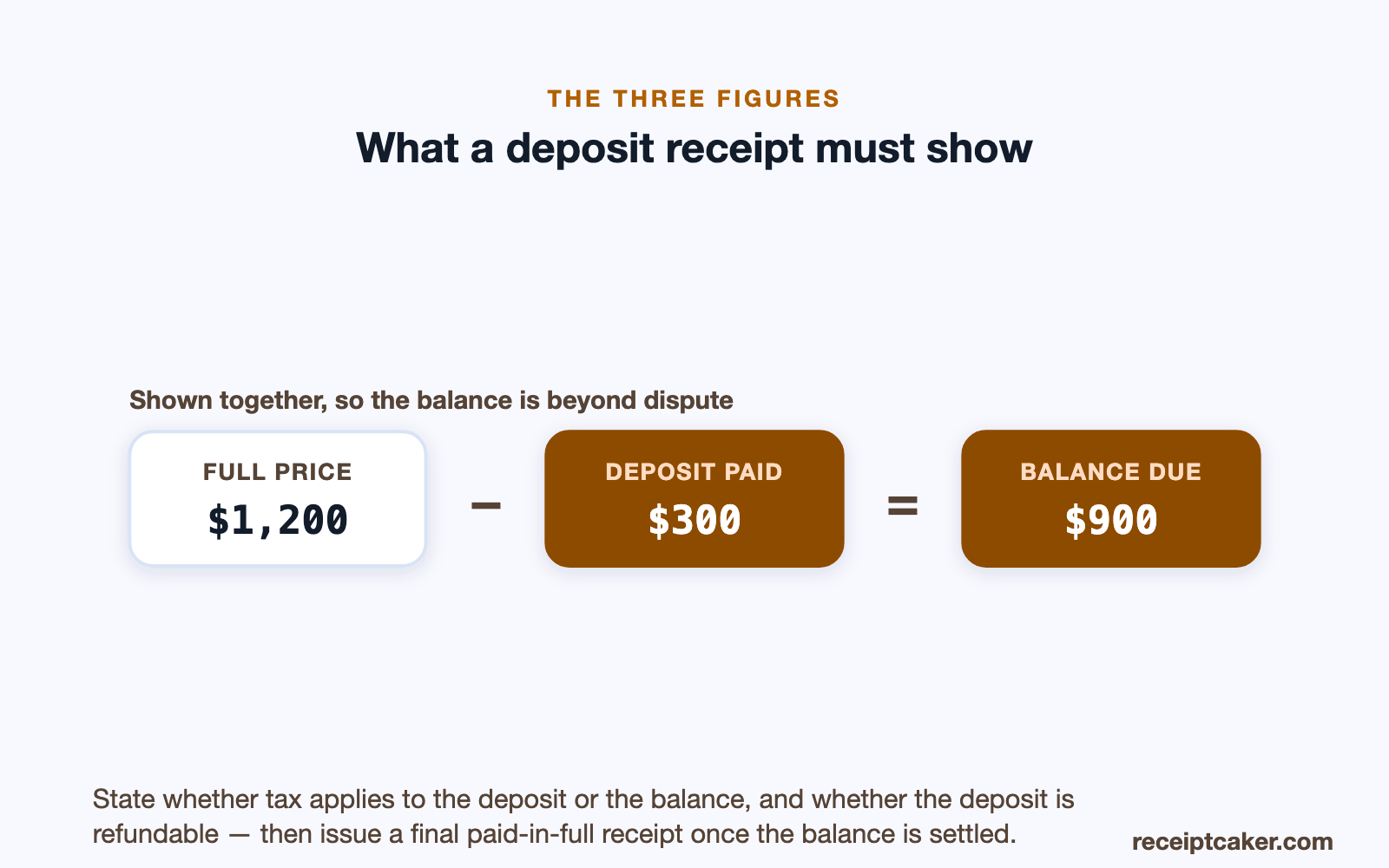
Every deposit receipt hinges on three figures shown together: the full price of the goods or service, the deposit amount just paid, and the remaining balance. Presenting them as a simple stack — total, less deposit, equals balance due — leaves no room for misunderstanding on either side.
Be explicit about tax as well. Decide and state whether the deposit is inclusive of tax or whether tax applies to the final balance, and show the tax line accordingly. When the numbers are laid out plainly and reconcile, the receipt does its job of protecting both parties; when they are vague, it creates exactly the argument it was meant to prevent.
Where deposit receipts are used
Deposits show up wherever a seller needs a commitment before delivering. A custom order — furniture built to spec, a bespoke cake, a tailored suit — usually takes a deposit to cover materials before work starts. Bookings and reservations for venues, trades, and events take one to hold the date. Repairs often need a deposit toward parts, and rentals take a security deposit against damage. In each case, money changes hands well before the transaction is complete.
That gap between paying and receiving is exactly why the receipt matters. The customer wants proof they have secured the goods or the slot; the seller wants a record that a commitment was made and how much is still owed. A clear deposit receipt gives both, and it is worth issuing even for informal arrangements where a handshake might otherwise be all there is.
Avoiding the classic deposit dispute
Most deposit arguments come down to two questions the receipt should already answer: how much is still owed, and whether the deposit comes back if the deal falls through. Get the three figures right and the balance is beyond dispute. State the refund terms plainly — refundable, partly refundable, or non-refundable, and under what conditions — and neither side can later claim they understood something different.
Vagueness is what causes trouble. A deposit receipt that reads like a full-payment receipt invites a buyer to think the item is paid off; one that says nothing about refunds invites a fight if they cancel. Spelling both out at the moment the deposit is taken, in plain language, is the whole point of the document — it turns a potential argument into a shared reference both sides agreed to up front.
Spell out the terms
A deposit receipt should record the terms attached to the money. Note what the deposit reserves — a specific custom item, a booking date, or the start of a job — and when the balance falls due, whether on completion, on delivery, or by a set date. This turns the receipt into a shared reference both sides can point to later.
Refund conditions deserve special care. State clearly whether the deposit is refundable, partly refundable, or non-refundable, and under what circumstances, since deposits are frequently intended to compensate the seller if a buyer backs out. Keep the language plain and legitimate — a deposit receipt documents an honest arrangement, not a way to trap either party.
Security deposits are a special case
Not every deposit is a down payment. A security deposit — common with rentals and equipment hire — is money held against damage or non-payment, not applied to a purchase price, and it is meant to be returned in full if nothing goes wrong. The receipt for one should make that distinction explicit: state that it is a security deposit, what it covers, and the conditions under which it is refunded, rather than implying it is a part-payment toward a total.
Some places regulate security deposits tightly — capping the amount, requiring it to be held separately or in a protection scheme, and setting deadlines for its return. Those rules vary by location and by what is being rented, so check what applies. Whatever the specifics, a clear dated receipt that names the deposit as a security deposit and records its terms is what protects both sides when it is time to return, or withhold, the money.
Number it and link the two receipts
Give the deposit receipt its own unique number and keep it in sequence with your other receipts, so the open item is easy to find and nothing slips through the cracks. Note the expected balance date on it too, which keeps the unfinished sale visible until it is settled rather than forgotten in a folder.
When the balance is eventually paid, reference the deposit receipt's number on the final paid-in-full receipt. That link ties the two documents together, so anyone looking at either one can see the whole story — a payment that arrived in two parts and was accounted for in full. Two connected receipts leave no ambiguity about what was owed, what was paid, and when.
Issue it and follow up
Record how the deposit was paid — cash, card, or transfer — give the receipt a unique number, and export it as a PDF so both parties keep an identical copy. Filing the deposit receipt with a note of the expected balance date keeps the open item visible until the sale is finished.
When the customer pays the remainder, issue a final receipt that references the deposit and shows the balance settled, so the two documents together account for the whole price. Receipt Caker makes this straightforward: itemize the order, enter the deposit, show the balance due on the deposit receipt, and later produce the final paid-in-full receipt from the same details.
Steps at a glance
- 1Label it clearly as a deposit. Mark the document as a deposit receipt so it is not mistaken for full payment of the total price.
- 2Record the parties and date. Add the seller's and payer's names, contact details, a unique receipt number, and the date the deposit was paid.
- 3State the total, deposit, and balance. Show the full price of the goods or service, the deposit amount paid, and the remaining balance still owed.
- 4Note the terms. Record what the deposit is for, when the balance is due, and any refund or forfeiture conditions.
- 5Add the payment method and issue it. Note how the deposit was paid, then export the receipt as a PDF and send a copy to the payer.