Money Receipt Generator
A money receipt is the simplest proof of payment there is: it records that a named person handed over a sum of money, what it was for, and when. Fill in who paid, how much, and the reason, and the builder below turns it into a clean receipt both sides can keep. It runs in your browser and exports free as an image.
- How do I write a money receipt?
- State who you received the money from, the sum received, what it was for, and how it was paid, then add the date and a line to sign. The builder lays this out as a receipt you can export free as a PNG or a Pro PDF and hand over on the spot. Money receipts matter most for cash payments — rent, a loan repayment, a deposit, a private sale — where there is no bank or card record, so a written one is the only proof either side has.
Optionale Zusatzzeilen, die unter der Kopfzeile gedruckt werden — z. B. Filial-Nr., Terminal, Bestellart.
Add your own total lines — a discount (use a negative amount), service charge, deposit or rounding. They fold into the total.
Write a money receipt in seconds
A money receipt is the plainest proof of payment there is: a signed note that a named person handed over a sum of money, what it was for, and when. It is not tied to an itemised sale like a store receipt — it simply confirms that money changed hands. The builder below turns that into a clean document: enter who paid, the sum, the reason, and the method, and the preview lays out a receipt both sides can keep.
It runs entirely in your browser, so the names and amounts stay on your device, and the receipt exports as a PNG for free. For someone who issues them regularly — a landlord taking rent, say — the Pro upgrade adds a watermark-free PDF and saves your details. The whole point is speed on the spot: a money receipt is usually written at the moment cash is handed over, so it needs to be quick to produce and immediately printable.
What goes on a money receipt
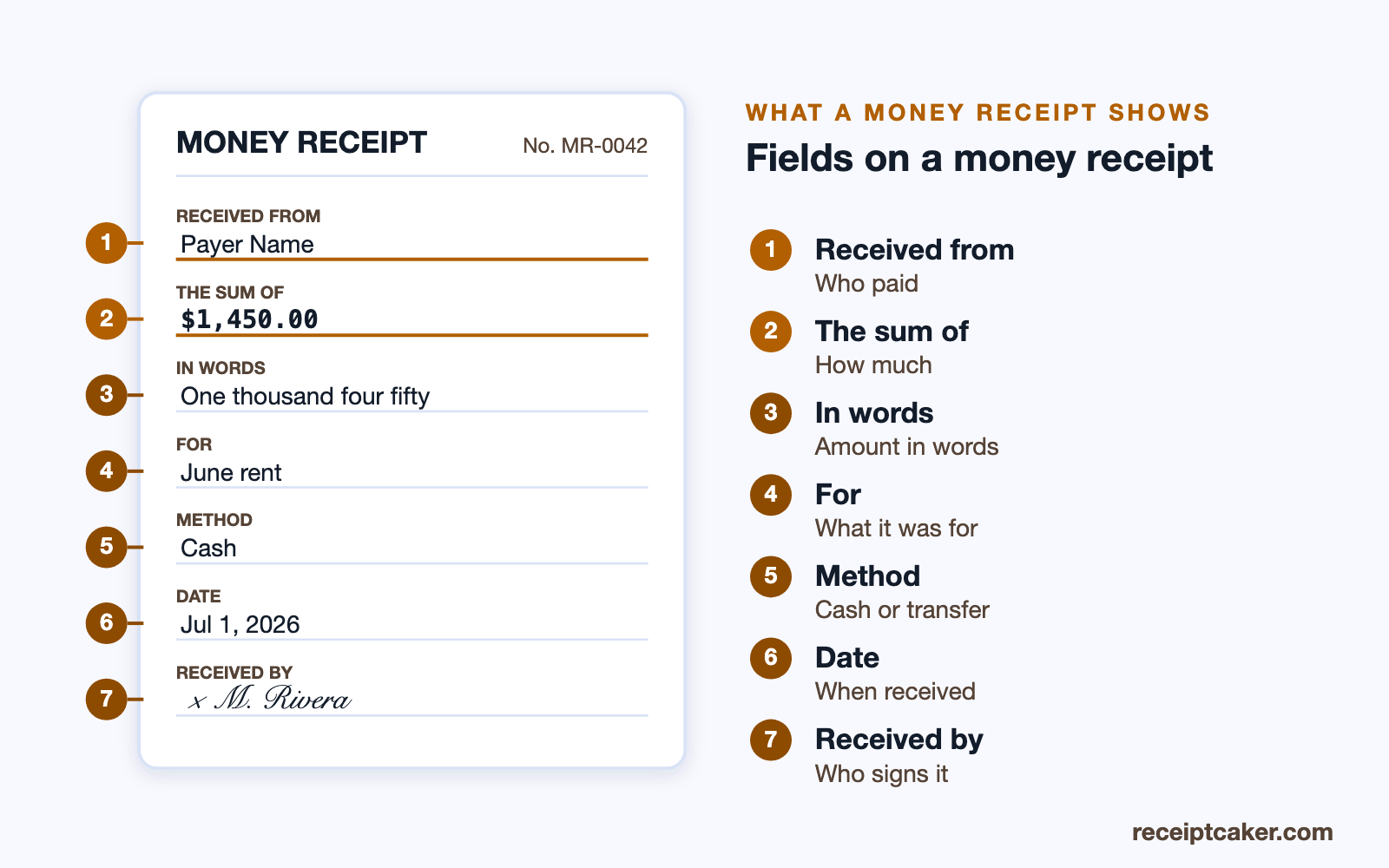
A money receipt names the person the money came from, states the sum — ideally in both figures and words so it cannot be altered — and says what the payment was for. It records the method, the date, and who received it, usually with a signature, plus a unique receipt number. Because it is so often the only record of a cash payment, that detail is what makes it hold up: a clear 'received from', an unambiguous amount, and a stated purpose.
The fields are few but each earns its place, as the diagram below shows. Spelling the amount out in words alongside the figures is an old habit worth keeping, since it stops a handwritten receipt being changed after the fact — the kind of small safeguard that matters when the receipt is the only proof either side holds.
Cash, rent, loans, and deposits
A money receipt earns its keep wherever money is paid without an automatic record. The clearest case is cash: a tenant paying rent, someone repaying a personal loan, a deposit handed over on a private sale, a reimbursement between friends, or a one-off cash payment for a small job. In each, there is no bank statement or card slip to fall back on, so the written receipt is the record both people rely on.
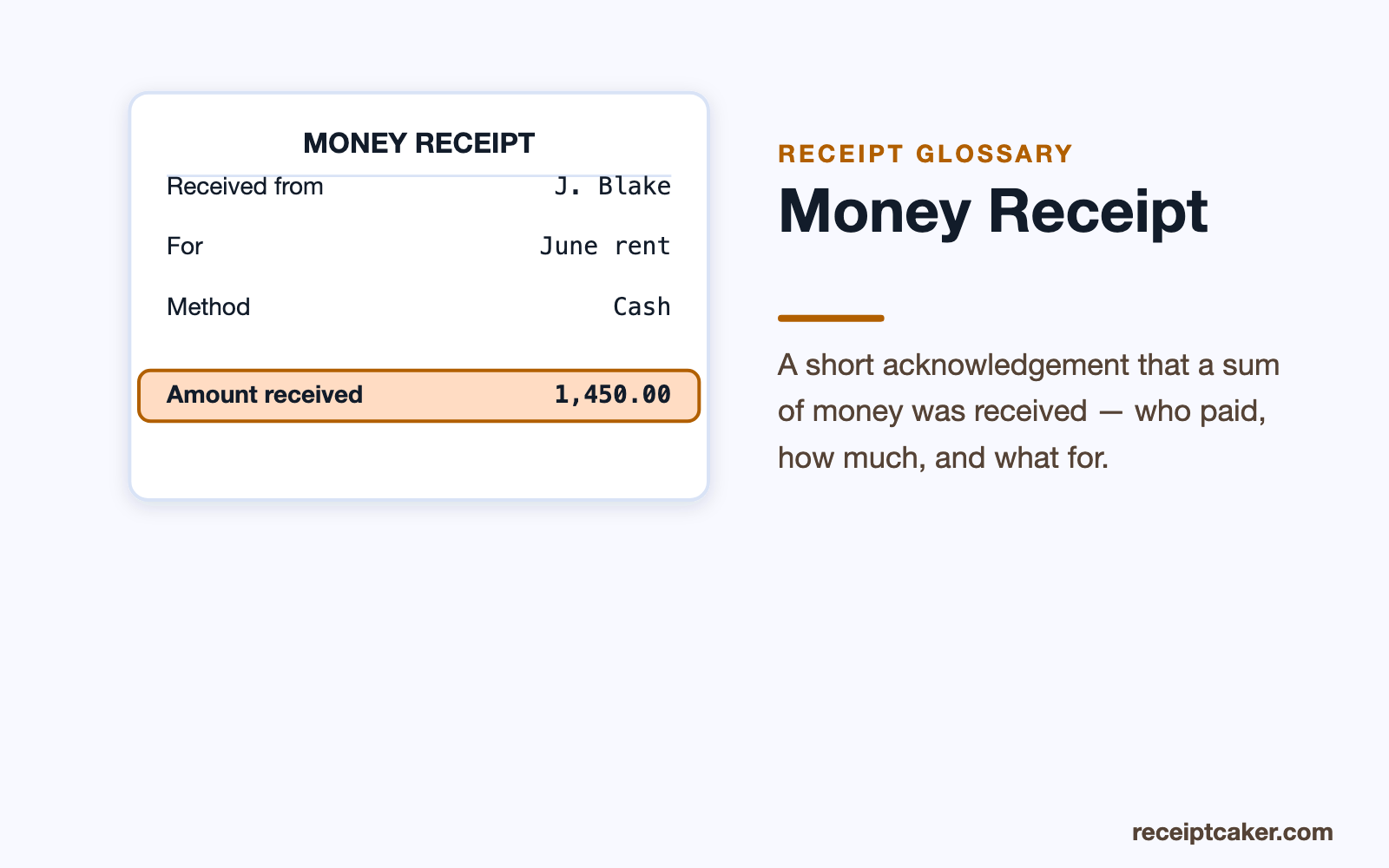
Issuing one on the spot, signed by whoever received the money, protects both sides equally — the payer has proof they paid, and the receiver has a clear note of what was for what. The example below shows a simple money receipt with the sum received highlighted; the same shape works whether the payment is a month's rent or a loan repayment.
Money receipt, invoice, or bill of sale
Three documents are easy to confuse, and choosing the right one keeps your paperwork honest. A money receipt is proof that a sum was received — it comes after the payment. An invoice is the opposite, a request for payment issued before, listing what is owed. A bill of sale goes further than either: it records that ownership of a specific item, like a car, passed from a seller to a buyer.
If all you need is to prove that money was received, the money receipt is the right and simplest choice. If you are asking to be paid, build an invoice instead; if you are transferring goods and need to document the change of ownership as well as the payment, the bill of sale generator captures that. Matching the document to what actually happened is what keeps the record accurate.
Honest proof of money received
A money receipt should record money that was genuinely received. Because it is often the only proof a cash payment ever happened, a receipt for money that never changed hands is not a shortcut — it is a false document, whether it is meant to fake proof of rent, support a bogus reimbursement, or mislead someone about a payment. Every sample in the builder, from the payer name to the sum, is a generic placeholder to replace with the details of a real payment.
Receipt Caker produces the receipt and nothing else. It does not receive, hold, or verify any money; it lays out and totals what you type, on your own device. Kept honest, a money receipt is simply how two people record a real cash payment and protect each other — which is the whole reason the document exists. Creating one for a payment that did not occur misrepresents it, and that is the misuse this tool is not for.