Auto Repair Estimate Generator
An auto repair estimate tells a customer what a fix will cost before you start — the parts, the labor hours, and an approximate total they can approve. List them, and the builder below totals the estimate with a date it holds until. It runs in your browser and exports free as an image.
- How do I make an auto repair estimate?
- Enter your shop and the customer, note the vehicle, and add a line for each part and for the labor hours at your rate. The builder totals them into an estimated cost, and you add a valid-until date. Export it free as a PNG or a Pro PDF for the customer to approve before you begin. An estimate is approximate — if the repair uncovers more than expected, you tell the customer and re-estimate, and the final invoice reflects the actual work done.
Filas adicionales opcionales impresas bajo el encabezado — p. ej. n.º de tienda, terminal, tipo de pedido.
Add your own total lines — a discount (use a negative amount), service charge, deposit or rounding. They fold into the total.
Quote a repair before you begin
An auto repair estimate tells a customer what a fix will cost before any spanner is turned. It sets out the parts the job needs and the labor to fit them, totals them into an approximate price, and gives the customer something to approve — which is not just courtesy but, in many places, a requirement before work begins. The builder below lays those lines out, totals the estimate, and lets you add a date the figure holds until.
It runs in your browser, so the customer and vehicle details stay on your device, and a complete estimate exports as a PNG for free. For a shop writing estimates all day, the Pro upgrade adds a watermark-free PDF and saves your shop details across them. The maths is handled for you, so a quick brake job and a bigger repair both add up correctly and read clearly for the customer.
What a repair estimate includes
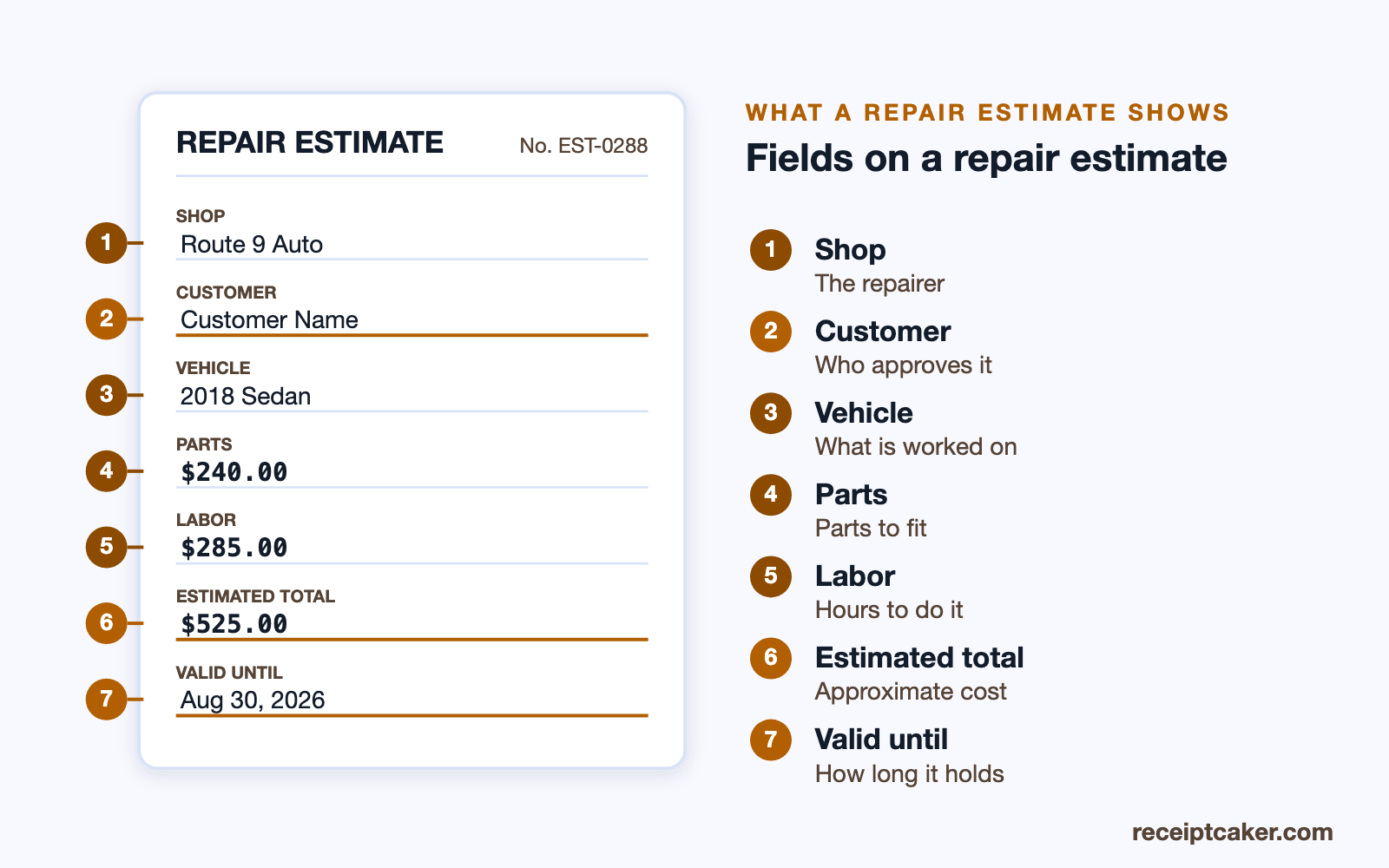
A repair estimate names your shop and the customer, identifies the vehicle by year, make, model, and often the VIN and mileage, and describes the work. It separates parts from labor: each part at its price, and the labor as the hours the job should take at your rate, with a diagnostic fee where one applies. Below the lines sit the estimated total and a valid-until date. Because a repair can grow once you are into it, a note that the figure is an estimate — and may change if more is found — belongs on the document.
That separation of parts and labor is what customers expect and what makes an estimate easy to follow. When each part and the labor are their own lines, a customer can see what they are paying for and question a specific item rather than the whole figure. The diagram below labels the fields a repair estimate carries.
Estimate versus the final bill
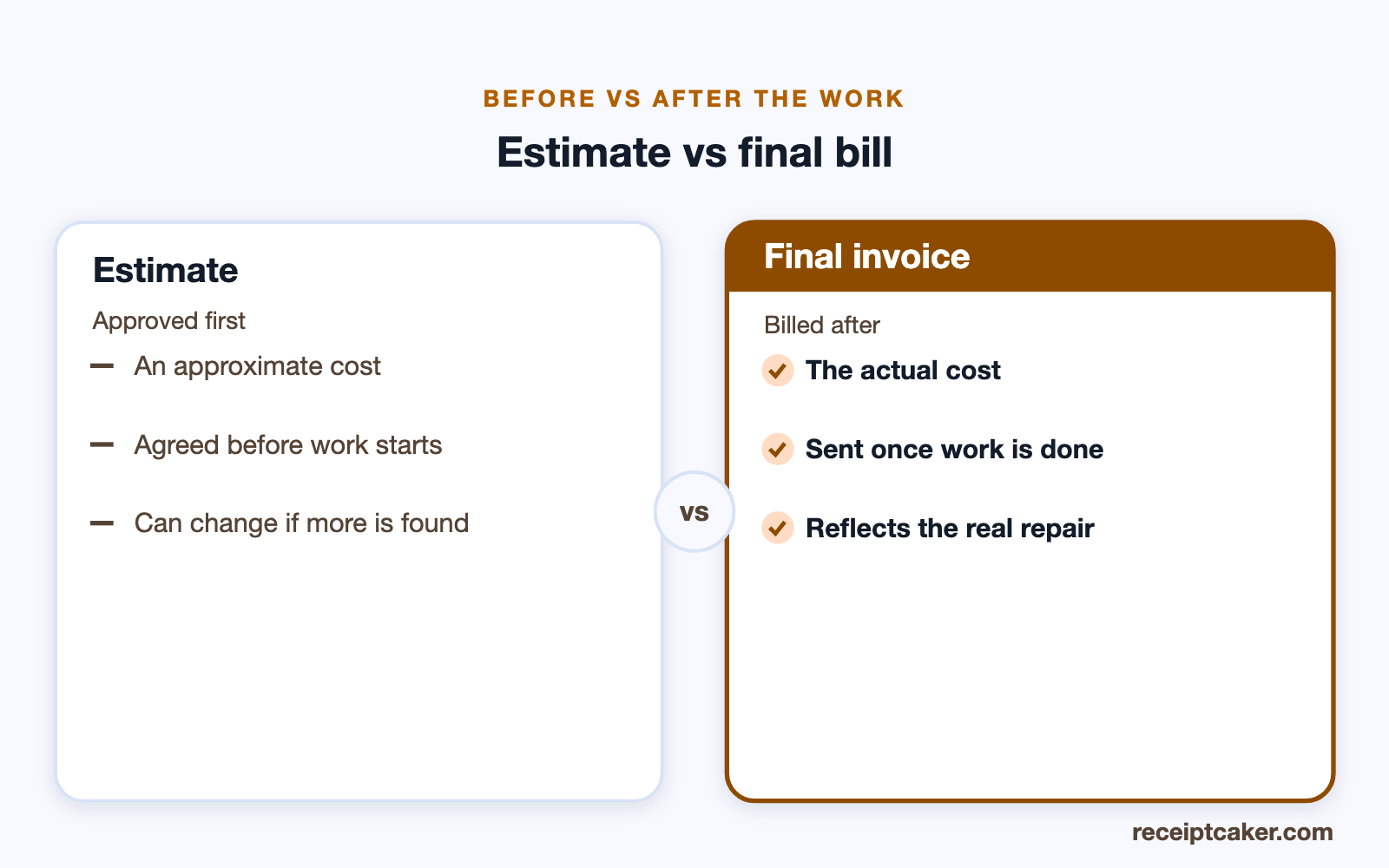
An estimate is the approximate cost given before the work; the final invoice is the bill for what was actually done. In auto repair the two often differ, because a job can reveal problems that were hidden at first — a seized bolt, a worn part behind the one being replaced, corrosion no one could see. That is normal, and it is precisely why the estimate is labelled approximate rather than fixed.
What matters is how the gap is handled. Telling the customer before the cost passes what they approved, and getting their agreement to the extra, keeps the final bill from being a shock. The final invoice is then built from the real parts and hours, not the original guess. The comparison below sets the estimate against the final bill; when the work is done, the free invoice generator produces that bill from the actual figures.
Getting approval before extra work
The estimate is the number the customer agreed to, which makes it a line you should not cross without a word. Good practice — and in many places the customer's legal right — is to contact them for approval before carrying out work that would take the bill beyond the estimate. Doing the extra work first and explaining afterward invites a dispute, and in some jurisdictions can mean you are not able to collect the difference.
Re-estimating when the job changes, and getting a fresh approval, keeps everyone aligned and your billing clean. The rules on this vary by state and locality, so check what applies where you operate; this is general practice, not legal advice. The generator makes issuing a clear revised estimate straightforward, so when a repair grows, the customer sees an updated figure to approve rather than a surprise on the final invoice.
Honest estimates, honest repairs
A repair estimate should reflect work the vehicle genuinely needs, at prices you actually charge. It is the basis on which a customer decides to go ahead, so listing parts that are not needed, padding the labor hours, or quoting a figure you do not stand behind turns a tool of trust into the opposite. Every sample in the builder — the shop, the customer, the vehicle, the line items — is a generic placeholder to replace with the real job.
Receipt Caker produces the estimate and no more. It does not diagnose the vehicle, do the work, or take payment; it lays out and totals what you enter, on your own device. Used honestly, an estimate is simply how a shop gives a customer a fair, clear price before the work — which is the whole reason to make one. Keep the estimates alongside the invoices they become; the IRS advises businesses to retain records generally for about three years.