Proof of Delivery Generator
A proof of delivery is the signed confirmation that goods arrived — who received them, which order they fill, and when. List what was delivered, add the recipient and a line to sign, and the builder below turns it into a clean delivery document. It runs in your browser and exports free as an image.
- How do I make a proof of delivery?
- Enter your business, the recipient, and the order the delivery fills, then list the items delivered and add the date and a signature line. Export it free as a PNG or a Pro PDF, print two copies, and have the recipient sign on arrival so both sides keep one. A proof of delivery confirms goods were received — it is different from a packing slip, which lists what is in the box but is not signed.
Lignes supplémentaires facultatives imprimées sous l'en-tête — p. ex. n° de magasin, terminal, type de commande.
Add your own total lines — a discount (use a negative amount), service charge, deposit or rounding. They fold into the total.
Confirm goods arrived, in writing
A proof of delivery is the document that closes a delivery: the recipient signs to confirm the goods arrived and were accepted, which settles any later question about whether they did. It records who received the delivery, which order it fills, what was handed over, and when. The builder below sets that out — enter the recipient and the order, list what was delivered, and add a date and a line to sign — and gives you a clean document to print and have signed on arrival.
It runs in your browser, so the recipient and order details stay on your device, and the document exports as a PNG for free. For a business making deliveries regularly, the Pro upgrade adds a watermark-free PDF and saves your details across documents. The signature happens on the printed copy at the point of handover, which is the moment a proof of delivery does its job.
What a proof of delivery includes
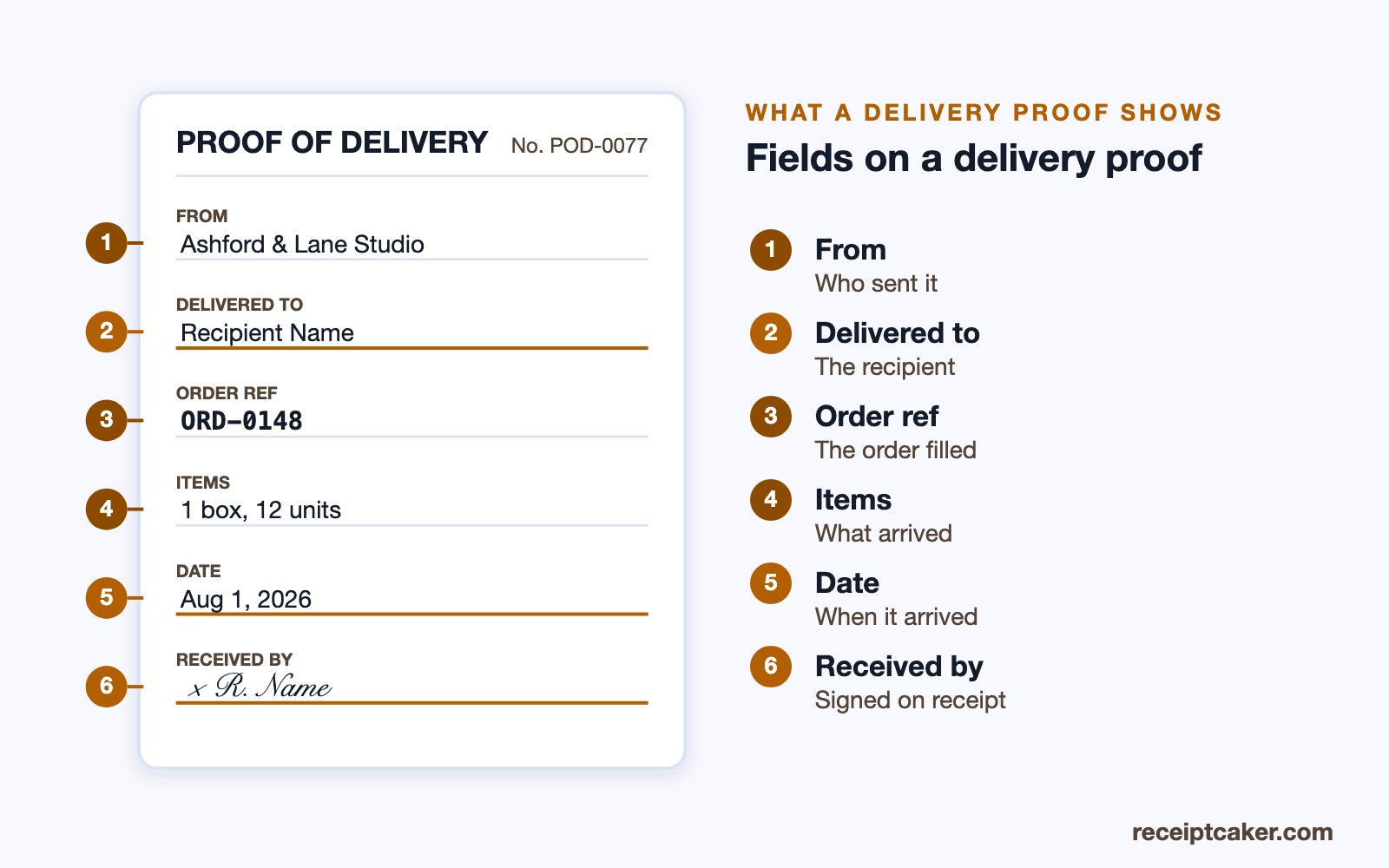
A proof of delivery names the sender and the recipient, gives the delivery address, and ties itself to the order, shipment, or tracking number it fulfils. It lists what was delivered — the items, or at least the number of packages — and records the date and, ideally, the time. The element that makes it more than a note is the recipient's signature, which confirms the goods were accepted. A line to note the condition of the goods on arrival is worth having too, so any damage is recorded at handover rather than argued about afterward.
Those fields turn a delivery into a documented event. When the recipient, the order, the contents, and the signature are all captured, the delivery has a clear record that protects both sides. The diagram below labels the fields a proof of delivery carries.
Proof of delivery versus packing slip
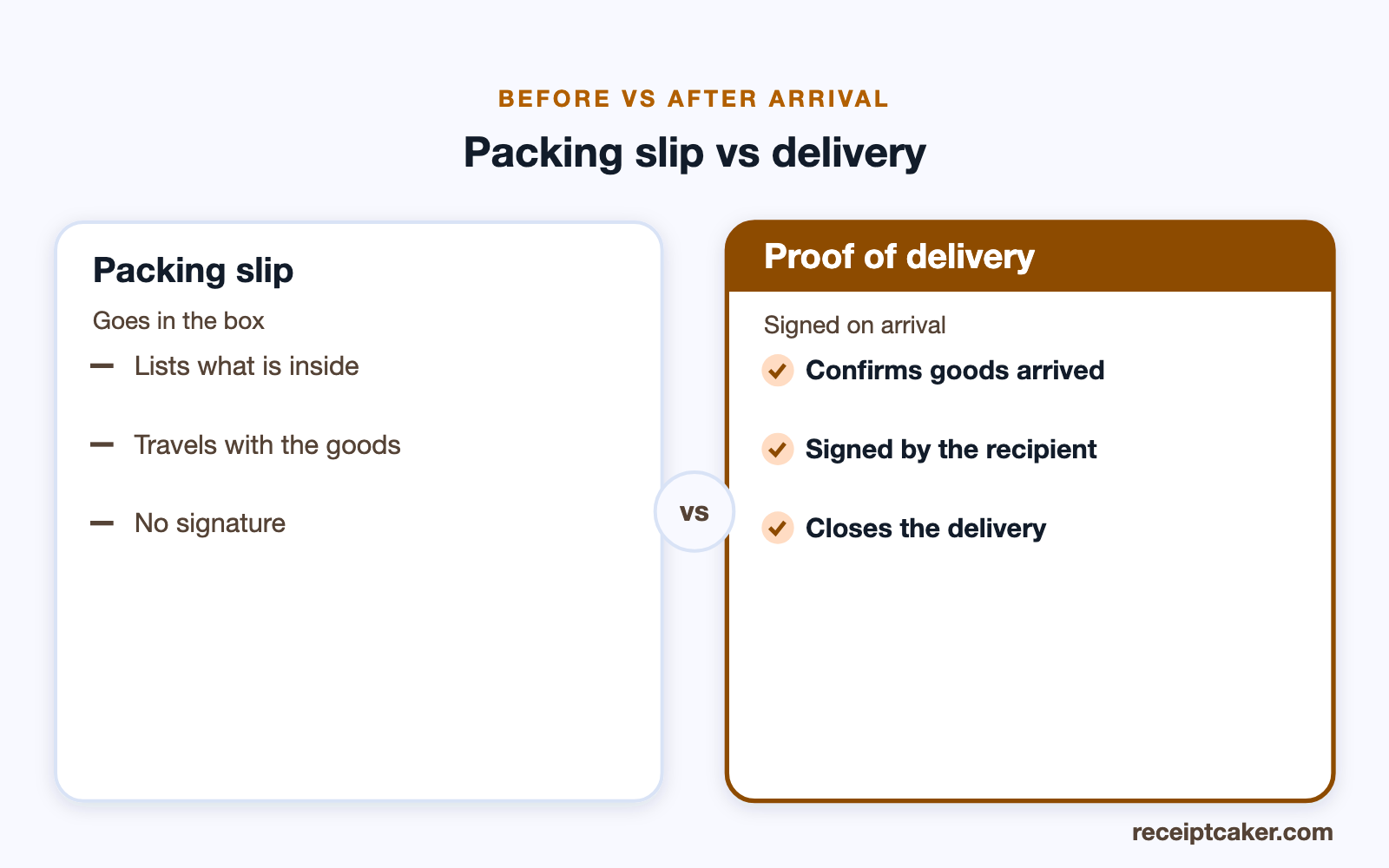
A packing slip and a proof of delivery are often confused because both accompany a shipment, but they do different jobs. A packing slip lists what is inside and travels with the goods, so the recipient can check the contents against it — but it is not signed and does not prove anything was received. A proof of delivery is signed on arrival and confirms the goods were handed over and accepted.
In many deliveries both are used: the packing slip goes in the box for the recipient to check off, and the proof of delivery is signed at the door to close the handover. If what you need is the contents list that ships with the goods, the packing slip generator produces that; this tool produces the signed confirmation that they arrived. The comparison below sets the two side by side.
Who relies on a signed delivery
A signed proof of delivery matters most to anyone whose work depends on goods actually arriving. Couriers and freight carriers collect one as evidence a shipment was delivered; e-commerce sellers and wholesalers use it to close an order and settle an 'it never came' dispute; and a small business dropping off its own goods uses it the same way. The signature is what gives it force — it marks the point at which responsibility for the goods passes to the recipient.
That is also why the document is worth producing properly rather than scribbling a note. A clean, numbered proof of delivery, tied to the order and signed on arrival, is a record both sides can rely on if a delivery is ever questioned — and questions tend to arrive long after the van has moved on, when memory alone is no help.
Honest proof of a real delivery
A proof of delivery should record a delivery that genuinely happened and goods that were genuinely received. Because it is signed evidence that a handover took place, creating one for a delivery that did not occur — to claim goods were sent, dispute a refund, or mislead a customer or carrier — is a false record, not paperwork. Every sample in the builder, from the recipient to the order reference, is a generic placeholder to replace with the details of a real delivery.
Receipt Caker produces the document and nothing more. It does not ship, track, or verify any delivery; it lays out what you enter, and the recipient's signature on the printed copy is what confirms the goods arrived. Used honestly, a proof of delivery simply records a real handover and protects both sides — which is the only reason to make one.